Invest in Women: Accelerate Progress
Policy Brief
2024
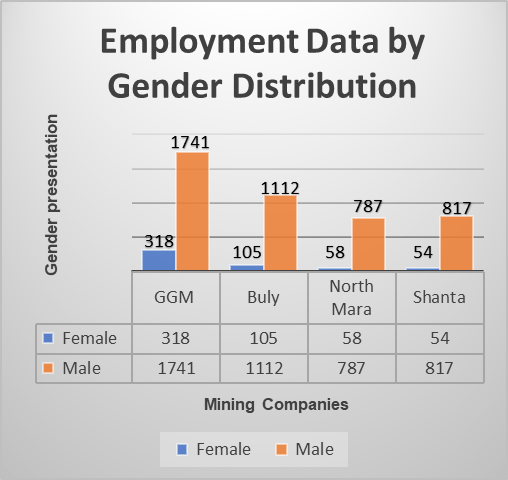
The mining sector stands as a cornerstone for economic growth and sustainable development in resource-rich nations, yet it grapples with a notable gender disparity. Extensively, studies underscore the differential impacts of extractive industries on men and women across various dimensions. Understanding these impacts is pivotal for devising policies and programs geared toward fostering inclusivity and empowerment.
Within the mining sector, women predominantly fall into three categories: those owning mining pits and licenses, service providers, value additions, and processing; those employed across skilled and unskilled roles within mining operations; and those residing in mining vicinities, affected by mining activities.
In Tanzania's mining sector, women confront formidable challenges that hinder their full participation and equitable benefit from the industry's resources. Despite the sector's economic significance, women find themselves marginalized, facing systemic barriers rooted in legal, cultural, and socio-economic factors. These obstacles relegate women to the fringes of decision-making processes and limit their access to opportunities for advancement within the sector.
The studies conducted by HakiRasilimali, FADEV, and the World Bank have illuminated the challenges faced by women in both revenue management and artisanal and small-scale mining (ASM) within Tanzania's mining sector.
Read the Briefing: https://www.hakirasilimali.or.tz/download/6318/?tmstv=1710487969
Within the mining sector, women predominantly fall into three categories: those owning mining pits and licenses, service providers, value additions, and processing; those employed across skilled and unskilled roles within mining operations; and those residing in mining vicinities, affected by mining activities.
In Tanzania's mining sector, women confront formidable challenges that hinder their full participation and equitable benefit from the industry's resources. Despite the sector's economic significance, women find themselves marginalized, facing systemic barriers rooted in legal, cultural, and socio-economic factors. These obstacles relegate women to the fringes of decision-making processes and limit their access to opportunities for advancement within the sector.
The studies conducted by HakiRasilimali, FADEV, and the World Bank have illuminated the challenges faced by women in both revenue management and artisanal and small-scale mining (ASM) within Tanzania's mining sector.
Read the Briefing: https://www.hakirasilimali.or.tz/download/6318/?tmstv=1710487969
Get This Resource
Publication Details
- Year
- 2024
- Published
- March 13, 2024
Resource Type
publication
Related Resources
Policy Brief
Policy Brief: Accelerating a Just and Inclusive Energy Transition in Tanzania
Tanzania's energy system is heavily reliant on fossil fuels, particularly natural gas, which accounts for over 50% of th...
2025
Read More